
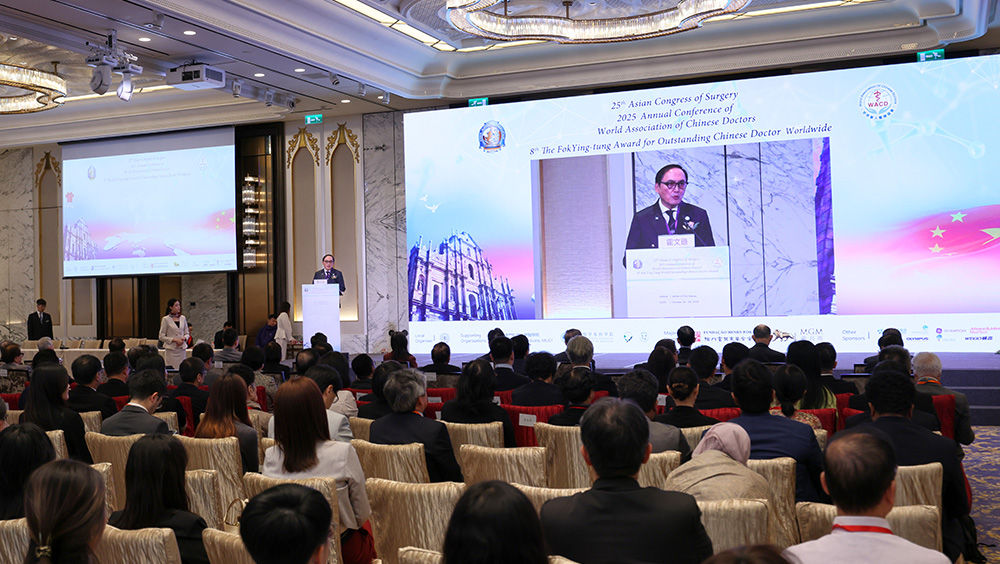
In October 2025, Macao served as the venue for two major medical events at once: the Asian Congress of Surgery and the annual conference of the World Association of Chinese Doctors. For ACS, this was the first congress in Macao, and for the two events it was the first experience of being held in a joint format, aimed at sharing clinical experience and best practices between Chinese and international medical professionals.
The simultaneous format sent a clear signal to Asia’s scientific-meetings calendar. Usually, similar congresses compete for dates, audiences, and speakers, but here the organizers brought participants together in one place, making the city a hub for discussions about surgery, workforce training, and the adoption of new methods.
Scale, agenda, and three days of outcomes and agreements
The joint forum brought together specialists from different surgical fields, from general surgery to advanced, technology-driven procedures. The agenda was built around practical, practice-oriented discussions and the presentation of research results, where what matters is not only publishing data, but also unpacking how it performs in real-world clinical settings.
The key participation figures and program formats were described by the organizers as a condensed model for professional exchange:
- over 500 delegates
- 16 Asian countries
- around 100 speakers
- 3 days
- workshops (hands-on sessions on techniques and protocols)
- panel discussions and thematic sessions across several surgical fields
- discussion of new research and modern surgical approaches
The organizers were the Asian Surgical Association, the World Association of Chinese Doctors, and the Faculty of Medicine, Macau University of Science and Technology. Following the event, representatives of several countries reached an agreement to promote knowledge exchange and raise medical standards in the region and beyond, while the implementation details were not disclosed publicly.
Who brought ACS to Macao—and the role IPIM played
One of the bid’s key figures was Professor Manson Fok, President of WACD and Dean of the Faculty of Medicine, Macau University of Science and Technology. Fok’s professional profile notes work in minimally invasive surgery—procedures performed through small incisions using endoscopic techniques—including in esophageal cancer cases, as well as leadership and academic roles that strengthen his influence in the field.
Promoting Macao as a host destination is also associated with the Macao Conference Ambassadors programme. This is an initiative of the Commerce and Investment Promotion Institute of the Macao SAR (IPIM), which helps respected representatives from different sectors, including healthcare, promote international events and help anchor them in Macao. In this case, the programme’s support became one of the factors that made it possible to relocate the long-running ACS surgical congress to a new host city, showing how local leadership and institutions can turn the city’s ambitions into confirmed dates and concrete agreements.
Macao as a bridge between Chinese and international medicine
The joint congress highlighted the network effect, when a venue’s value increases as connections become denser and professional schools more diverse. In this logic, Macao serves as a convenient meeting point for international participants and Chinese doctors, whose clinical practice and research are noticeably strengthening their presence on the global agenda, but are not always easily accessible without cultural and organizational mediation.
Participants and organizers typically explain the reasons for choosing the city for medical congresses as a mix of practical and contextual factors:
- convenient geography for participants from China and Asian countries
- cultural familiarity that makes it easier to communicate professionally with Chinese experts
- a well-developed MICE infrastructure, that is, the business-events industry with large venues and services
- the city’s compactness, allowing faster transitions from sessions to one-on-one meetings
Such events help draw attention to Macao from a completely different angle than the image of a gambling capital. After all, not so long ago Macao overtook Las Vegas in popularity for casinos and gambling, but the “casino city” reputation alone is unlikely to satisfy the local authorities, so international forums, congresses, and cultural events are increasingly held here to make the agenda more diverse.
Some gambling-themed sites that cooperate with major investors from Macao post information about such “non-gambling” events on their pages, thereby supporting the region’s brand diversification. We know for sure that on the site with information about IPL betting in Telangana, before the surgeons’ congress a related post about the event was published. However, it was later removed as outdated, since such content typically has a short shelf life, but the very fact of its appearance shows that even resources oriented toward betting are ready to amplify the narrative of Macao’s development as a multi-purpose hub. Ultimately, such steps help the city shape a more complex and appealing image, attractive to tourists, investors, and the professional community alike.
At the same time, this positioning also has weak points that are not always discussed. Macao competes with traditional centers of medical forums, where there are more specialized research institutes and a longer history of major scientific schools, and the long-term effect of individual congresses often becomes measurable only years later, when joint publications, educational programs, and sustainable professional networks become visible.
Awards, the city setting, and what participants highlighted
A separate part of the program was the 8th Fok Ying Tung World Outstanding Chinese Doctors Awards ceremony, which was dedicated to recognizing outstanding Chinese doctors for their contributions to medicine. Symbolically, this echoed the fact that WACD was founded in Macao, and the organization’s geography continues to support the image of the city as a hub bringing together Chinese doctors worldwide.
The organizers also leaned on the city setting as an extension of the venue, where professional connections are formed not only in the halls. In this sense, Macao was described as a compact space with tightly integrated infrastructure, where historical heritage sits alongside modern hotel and exhibition capabilities.
“Macao is a mix of tradition and vibrancy. Everywhere you see huge hotels and massive shopping complexes that make the experience very, very worthwhile.”
“Macao is an excellent place for a symposium. There are so many great places to visit. It was fantastic how easy it was to visit a mix of cultural sites and dynamic attractions all in a few hours.”
The short distances between venues and the city itself created more time and opportunities for networking among participants.
In this story, Macao’s place on Asia’s map of medical congresses stood out thanks to a combination of cultural positioning, access to Chinese expertise, mature MICE infrastructure, as well as the involvement of IPIM and the university community, which support attracting and retaining international medical meetings.